
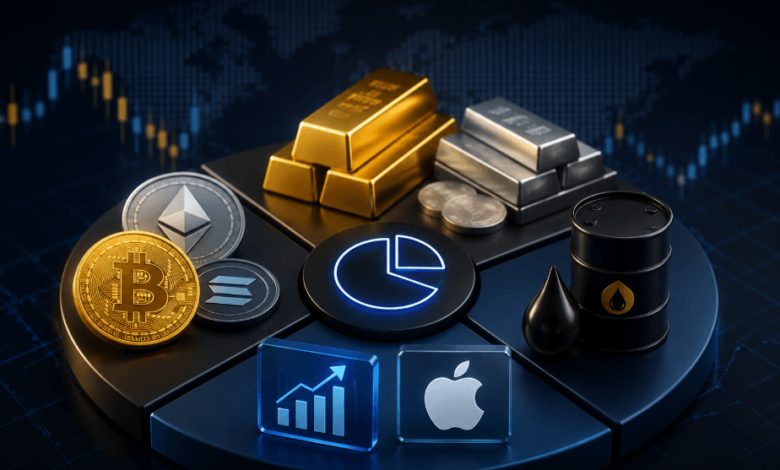
Why Crypto Diversification Matters More Than Ever
Relying entirely on a mix of Bitcoin and volatile altcoins can leave portfolios highly exposed during deep market downturns. Because the broader crypto landscape remains heavily correlated, a sudden correction often drags down nearly every token simultaneously.
To hedge against this systemic risk, the digital asset ecosystem has shifted toward multi-asset investing. Financial technology is radically expanding how investors manage capital. Instead of jumping between separate brokerage apps, bank accounts, and hardware wallets, you can now build a comprehensive, cross-asset portfolio right from your primary trading ecosystem.
What Is Crypto Portfolio Diversification?
True diversification goes beyond simply splitting capital across five different layer-1 tokens or decentralized finance (DeFi) projects. If every asset in a portfolio shares the same structural risks, the portfolio isn’t actually diversified.
Instead, institutional portfolio construction focuses heavily on correlation, a mathematical measure of how two assets move in relation to one another.
- Positive Correlation ($+1.0$): The assets move in tandem.
- Negative Correlation ($-1.0$): The assets move in exact opposite directions.
- Zero Correlation ($0.0$): The assets move with complete independence.
By adding traditional asset classes with low or negative correlation to crypto, you effectively spread risk across entirely distinct economic environments.
Why Commodities Are a Valuable Addition to a Crypto Portfolio
Physical commodities operate on entirely different fundamental loops than digital tokens. While crypto relies heavily on technological adoption, liquidity cycles, and network growth, commodities are driven by manufacturing demand, global trade, and geopolitical supply chains.
- Gold (XAUUSDT): The quintessential safe-haven asset. Gold acts as a monetary anchor during periods of intense high inflation or banking sector instability.
- Silver (XAG): A unique hybrid asset. Silver tracks macroeconomic precious metal trends but also responds to real-world industrial demand, particularly in solar panel production and electronics.
- Oil: A highly growth-sensitive macroeconomic indicator. Crude oil reacts directly to international industrial outputs, transport demand, and structural geopolitics.
In some market cycles, commodities, especially gold, may help preserve purchasing power or reduce portfolio volatility, although their performance still depends on inflation, interest rates, demand, and geopolitical conditions.
What Are Tokenized Assets and Why Are They Growing So Fast?
Tokenized real-world assets (RWAs) are digital representations of traditional financial instruments living on public blockchains. According to CoinGecko’s 2026 RWA Report, tokenized commodities grew to about $5.55 billion by March 2026, with most of the growth driven by tokenized gold products such as PAXG and XAUT. The broader on-chain RWA landscape reached a total of $19.32 billion in market capitalization (excluding stablecoins) by the close of Q1 2026, capturing an increasingly massive slice of decentralized volume.
Tokenization builds a direct pipeline between traditional capital markets and decentralized finance. Instead of waiting days for standard banking rails to clear a wire transfer to a legacy broker, crypto investors can trade fractional units of gold or silver instantly, 24/7. This lowers minimum capital entry barriers and introduces true global accessibility.
How Traditional Stocks Can Complement Crypto Investments
Crypto investors frequently seek stock market exposure to capture corporate revenue streams without dealing with legacy financial friction. Platforms offering equity integrations allow users to manage blue-chip US equities or index funds alongside their digital currency balance.
MEXC Real Stocks are not tokenized stocks. They provide broker-connected access to real US-listed equities, allowing users to buy and hold real shares alongside crypto assets in a unified trading experience. This means investors secure genuine market exposure and real ownership rights, including dividends where applicable, rather than holding synthetic or on-chain proxy tokens.
Furthermore, integrating US Stock Futures alongside digital assets allows strategic traders to hedge macro risks, profit from broad market indices, and capitalize on earnings seasons directly from their integrated dashboards.
Comparing Crypto, Stocks, and Commodities
| Feature | Cryptocurrencies (BTC, ETH) | RealStocks (MEXC Equity Integration) | Tokenized Commodities (Gold/Silver) |
| Primary Driver | Network adoption, liquidity | Corporate earnings, economic growth | Industrial supply/demand, inflation |
| Average Volatility | High | Moderate to High | Low to Moderate |
| Trading Hours | 24/7/365 | Traditional US market hours | 24/7 on-chain, tracks global spot |
| Asset Structure | Native digital tokens | Real broker-held equities | On-chain digital claims |
Gold vs. Bitcoin: Do Investors Need to Choose?
While critics view them as rivals, gold and Bitcoin actually share structural similarities: both feature strict scarcity and operate entirely outside the centralized banking system.
Bitcoin and gold often play different roles in a portfolio. Bitcoin is typically more volatile and growth-oriented, while gold is generally viewed as a more mature safe-haven asset. Owning both allows an investor to capture aggressive technology upside while establishing a baseline capital safety net.
Designing a Diversified Portfolio Structure
How you blend these options depends heavily on your timeline and risk tolerance:
- Conservative Allocations: Focus heavily on capital preservation. A typical structure might consist of 50% Gold/Treasuries, 30% Blue-Chip US Stocks, and 20% major cryptocurrencies (BTC/ETH).
- Balanced Allocations: Aim for a steady mix of growth and defense, utilizing 40% Crypto, 30% RealStocks/Stock Futures, and 30% Commodity Futures (Oil/Precious Metals).
- Growth-Oriented Allocations: Maximize upward momentum while keeping a safety net. This involves 70% Cryptocurrencies and Altcoins, 20% US Stock Futures, and 10% highly liquid gold products.
Regardless of your structure, consistent portfolio rebalancing (e.g., quarterly or after a 10% market shift) is vital. Selling a portion of your winning assets to buy undervalued asset classes ensures you consistently lock in profits and keep your target risk profile perfectly intact.
How Investors Access Commodities and Equities Today
Gaining exposure no longer requires bridging funds across multiple completely separate networks. Modern platforms let you navigate multiple financial landscapes simultaneously:
- Commodity Futures via On-Chain Derivatives: Traders can utilize decentralized perpetual protocols to gain capital-efficient exposure to Gold, Silver, and Oil futures contracts.
- Asset-Backed Tokens: Gold-backed tokens such as XAUT and PAXG are designed to represent claims on allocated physical gold, with custody, reserve reporting, and redemption terms depending on the issuer. According to CoinGecko’s data, these products dominate the tokenized commodity niche, backed by physical bullion vaulted in Swiss and London (LBMA) vaults respectively.
- Unified Trading Platforms: All-in-one platforms like MEXC allow users to seamlessly manage native digital assets, genuine equity shares via RealStocks, and macro futures products under one unified account interface.
Risks and Considerations Before Diversifying
Multi-asset investing introduces clear advantages, but it also carries unique risks:
- Commodity Market Dynamics: Commodity prices can face sharp downward pressure from sudden macroeconomic shifts, changes in industrial manufacturing cycles, or sudden inventory gluts.
- Tokenization Smart Contract Risks: Unlike physical gold in a home safe, tokenized assets depend entirely on the security of smart contracts and the transparency of the issuer’s off-chain custody audits.
- Over-Diversification: Spreading capital too thin across dozens of highly specialized financial products can dilute returns and generate excessive transaction fees.
The Future of Multi-Asset Portfolios
The marriage of traditional finance (TradFi) and crypto environments is rapidly accelerating. Major global asset managers have validated the infrastructure by scaling multi-billion-dollar treasury funds on public chains, while top crypto networks are onboarding direct broker links. As global regulatory frameworks mature, the transition toward permanent, multi-asset digital architectures will shift from a niche alternative to the absolute baseline of modern portfolio management.
Frequently Asked Questions
What is the best way to diversify a crypto portfolio?
The most effective approach is adding non-correlated assets. Move beyond simply holding multiple altcoins by allocating a structural portion of your capital to traditional equities, precious metals, or macro futures.
Should I invest in gold and Bitcoin at the same time?
Yes. Bitcoin offers high-risk, exponential growth potential, while gold acts as a highly stable macroeconomic hedge. Combining them stabilizes a portfolio’s equity curve during intense market drawdowns.
What are tokenized assets and how do they work?
Tokenized assets are on-chain digital representations of real-world tangible goods or traditional securities. An issuer holds the underlying physical asset in custody and mints equivalent cryptographic tokens 1:1 on a blockchain network.
How much of a crypto portfolio should be allocated to commodities?
Depending on your overall risk tolerance, standard diversified frameworks generally suggest allocating anywhere from 10% (for aggressive growth portfolios) up to 50% (for highly conservative capital preservation models) to commodities and safe-haven instruments.
What are RealStocks, US stock futures, and commodity futures?
RealStocks are real, broker-connected US equity shares managed directly inside a crypto ecosystem. Stock and commodity futures contracts are financial agreements allowing traders to speculate on or hedge against the future prices of market indices and physical resources with optimal capital efficiency.